Ceremonial Grade Matcha – how to recognize it
Between two green powders sometimes lie three weeks of shading, a hand harvest, and an hour in a stone mill.
What's in this can
Four details that make a difference in matcha – and that many suppliers don't disclose.
Harvest Time
1. Picking
Growing regions
1
Fineness of grind
120 mesh
Per cup
CHF 0.79

Why We Grind Tea and Press Grass
Those familiar with our juice powders will rightfully stumble here: We otherwise argue against grinding. With matcha, we do it ourselves – and that's not a contradiction, but the same rule applied in two directions.
With grass, the fiber is the problem. It makes up the largest part of the plant, doesn't dissolve, and dilutes what matters. That's why we press it and keep only the juice. Why this is the more elaborate but correct method for grass is explained on the comparison page.
With tea, the leaf is the product. Matcha is, by definition, the entire leaf body whisked into water – there is nothing to separate. What makes the difference happens beforehand on the bush: three to four weeks under nets before harvesting even begins.
So, the same rule applies: the process that the raw material demands. For one, it means pressing; for the other, it means grinding.
Four steps you can taste
No seal of approval, but craftsmanship."Ceremonial" is not a protected term. What actually lies behind it are four decisions in cultivation and processing.
Prefer green, but without caffeine? Then the Barley Latte made from barley grass is the perfect alternative for the late evening.
Ceremonial Matcha and Culinary Grade
"Matcha" says nothing about quality. Right column: cheaper matcha, as it usually sits on the shelf.
 Pier
Pier
For baked goods and strong lattes, cheap matcha is perfectly fine. For a pure cup, it is not.
Cost of a cup
30 grams doesn't sound like much. One to two grams are needed for a cup of Usucha – so the tin lasts about a month.
Per cup
CHF 0.79
Cups per can
30
Content
30 g
Organic content
100%

Usucha or Koicha
Usucha is the everyday preparation: one to two grams of matcha, around 200 milliliters of water at 70 to 80 degrees Celsius, whisked with a bamboo whisk until a fine layer of foam forms. Mild, light, for every day.
Koicha is the concentrated form: the same amount of powder or more in only about 50 milliliters of water. Not whisked, but slowly stirred until a thick, dark green paste forms. Intense, syrupy, and for this, ceremonial quality is truly needed – any bitterness emerges unfiltered here.
Important in both cases: The water must not boil. Above 80 degrees Celsius, matcha becomes bitter, and this bitterness cannot be removed.

Directly from Miyazaki, without intermediaries
Miyazaki, located in southern Japan, is not the region that first comes to mind when one thinks of Matcha – Uji and Nishio are more well-known. That's precisely why the farm there is interesting: smaller quantities, high accolades, and a producer with whom we can speak directly instead of through a trading chain.
There's a practical reason for this. With Matcha, almost everything is decided during cultivation: shading duration, harvest time, leaf selection. If you obtain this information through three intermediaries, you eventually lose it.
Every batch is traceable, organically certified, and undergoes a dual inspection – by the producer in Japan and additionally by an independent laboratory in Germany.
Organic Premium Matcha Piēru Ceremonial
Hand-selected first harvest Tencha leaves, two-stage shaded, ground on granite stone mills. A single origin, a single producer, every batch double-checked.
Shipping with Swiss Post · Orders placed by 6 PM dispatched the same day
Double lab-tested
With the manufacturer in Japan and in Germany

What's included – and what's not
-
100% Tencha – nothing added, no flavorings
-
First Flush, hand-picked
-
Single Origin from Miyazaki Prefecture
-
Stone-ground – about one hour per can
-
Organic certified, lactose-free and vegan
Four things: the harvest time, the harvest method, the duration of shading, and the grinding method. Ceremonial matcha comes from the first flush, is hand-picked, shaded for a long time, and slowly stone-ground. Cheaper matcha cuts corners on at least one of these four points – usually all of them.
Because every single step is elaborate. Shading costs the farmer three to four weeks of growth, hand harvesting yields only a fraction of machine-harvested quantities, and the stone mill takes about an hour for 30 grams. Calculated per cup, it relativizes: one to two grams yield around 79 centimes.
For usucha, yes, if you want the fine foam layer - a chasen distributes the powder differently than a spoon or a milk frother. It is not absolutely essential: for a matcha latte, an electric frother is sufficient. For koicha, it is stirred rather than whisked anyway.
Matcha naturally contains caffeine. At one to two grams per cup, the content is roughly at espresso level, depending on the dosage. For many, this is too much for the late evening – in which case barley grass is the more obvious alternative.
Above about 80 degrees, matcha releases more bitter compounds. This makes the tea astringent and flat, and this cannot be undone. 70 to 80 degrees is the range where sweetness and umami remain prominent.
Two completely different plants and two different processes. Matcha is ground tea leaf and contains caffeine. Barley grass juice powder is pressed plant juice from young grass and does not contain any. In terms of taste, matcha is tart-umami, barley grass is mildly green.
Matcha loses quality primarily through light, heat, and oxygen. Store it in a cool, dry, and dark place, and seal the tin tightly after each use. Consumed within a few weeks, it tastes significantly fresher than after months – the color is the first indicator of this.
By colour and smell. Good matcha is bright, almost neon green, and smells sweetly grassy. If the powder looks dull, yellowish, or brownish, the shading was too short, the harvest was too late, or the tin was open for too long. In the cup, this manifests as bitterness in the finish.
-
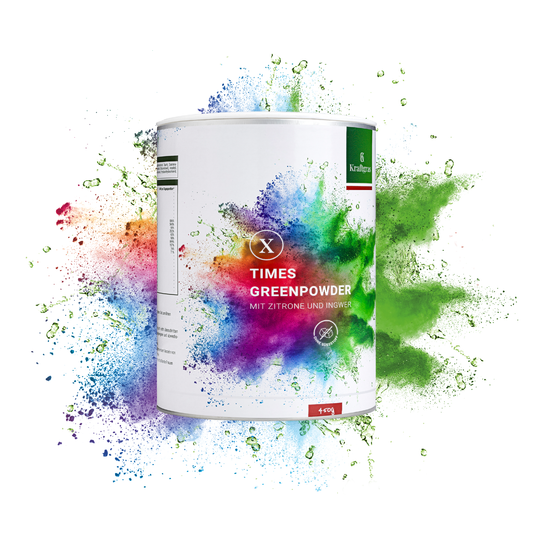
Times Green Powder
Still tired? – not much longer.
Regular price CHF 43.00Regular priceUnit price CHF 95.56/kgCHF 0.00Sale price CHF 43.00 -
Organic Premium Matcha Piēru Ceremonial
Selected organic matcha from one of Japan's most renowned, multi-award-winning tea farmers.
Regular price CHF 23.90Regular priceUnit price CHF 796.67/kgCHF 29.90Sale price CHF 23.90Sale -
 Sold out
L-Theanine
Reines L-Theanin, die natürliche Aminosäure aus dem Grüntee, in veganen Kapseln.
Regular price CHF 0.00Regular price -
Sold out
Taurine powder
100% pure, top-quality taurine powder – the ideal partner for targeted supplementation of your daily diet.
Regular price CHF 0.00Regular price