Juice powder or grass powder?
Same sheet, two methods – and a significant difference.
Kraftgras Quality – No Compromises
We only make juice powders. No milled grass, no fillers, no compromises.
Juice powder
100%
Organic Ingredients
100%
Fresh grass per kg
33 kg
Per serving
CHF 0.65
Juice Powders vs. Grass Powders
Same plant, two processes – and thus two very different products. Right column: commercially available ground grass powder.
 Powergrass
Both variants are justifiable. We have deliberately chosen the more complex procedure.

Why We Only Produce Juice Powders
Barley grass, wheatgrass, and alfalfa are available in two forms commercially. In the case of grass powder, the entire plant is dried and ground – the insoluble plant fibers make up the largest part of the powder.
With juice powder, the fresh plant is pressed. Only the juice is processed further; the fibers are separated. Approximately 33 kilograms of fresh grass are needed for one kilogram of finished juice powder. This is precisely where the price difference comes from – and the significantly higher concentration per serving.
Honestly, grass powder isn't bad because of this: Anyone who specifically wants to consume fiber is well served by it. We are concerned with something else – a powder that dissolves without residue, is well tolerated even by sensitive digestion, and contains as much plant juice as possible in one teaspoon. Juice powder is the right method for this.
What Juice Powder Costs in Everyday Life
CHF 31 for one can sounds like a lot. Calculated per serving, it's 65 rappen – about a quarter of the cost of a coffee. The refill bag makes it significantly cheaper, with identical origin and quality.
Per serving
CHF 0.65
With refill bag
CHF 0.49
Refill saves
25%
Per month
CHF 19.50

How our juice powder is made
The fresh plants are pressed immediately after harvesting. Only the pure plant juice is used, which is then gently dried. Insoluble plant fibers are removed during this process. This results in a concentrated, intensely green organic juice powder with a fine texture and good solubility.
Less than 45 minutes pass from the time of harvest to the finished juice powder. This is the most complex part of the process – and the reason why color, smell, and solubility remain consistent across all batches.

Origin Utah
Our organic barley grass grows in Utah on soils that have been mineral-rich for millions of years due to marine deposits and volcanic activity. Together with the dry climate and intense sunlight, these conditions are reflected in the color, purity, and consistency of the juice powder.
The raw material comes from Utah, Kraftgras itself is located in St. Gallen. Bottling and distribution are carried out directly from Switzerland.
Four Juice Powders, One Process
Same diligence, different character.All varieties are obtained using the same process: pressed, filtered, gently dried.
Unsure which variety suits you best? Send us a quick message.
The Easiest Way to Get Started
Barley, Kamut® Khorasan, Wheat, Oats and Alfalfa – in equal parts, each variety as pure juice powder. If you want to know what juice powder tastes and feels like, start here. That's about 60 Rappen per serving.
Shipping with Swiss Post · Orders placed by 6 PM dispatched the same day
Laboratory-tested organic quality
No additives, no fillers

What's included – and what's not
-
Pure Juice Powder – no ground plant fibers
-
Five types of grass combined in equal parts
-
Certified organic from controlled organic cultivation
-
Dissolves completely in water, juice or smoothies
-
No additives – no flavourings, sweeteners or fillers
What Our Customers Say
Selected reviews from our shop.
200g Organic Barley Grass Juice Powder
Barley in the evening - soothing and simply brilliant for an upset stomach!
Organic Wheatgrass Juice Powder
Exactly the right green for my everyday life. Provides the necessary energy for the day.
Organic Barley Grass Juice Powder
Love the powder. Feeling great. Great quality.fast delivery.💟
Organic Barley Grass Juice Powder
Great quality, I will definitely order again!
-
Organic Barley Grass Juice Powder
Premium juice powder in organic quality - without additives
Regular price CHF 31.00Regular priceUnit price CHF 155.00/kg -
Organic ancient wheatgrass juice powder (Kamut® Khorasan)
Premium juice powder in organic quality - without additives
Regular price CHF 31.00Regular priceUnit price CHF 155.00/kg -
Refill bag barley grass juice powder
Our barley grass juice powder from Utah is available as an affordable refill bag – identical in origin and quality, but with more content at a great price.
Regular price CHF 58.00Regular priceUnit price CHF 116.00/kg -
Refill bag of ancient wheatgrass juice powder (KAMUT® Khorasan)
Our KAMUT® Khorasan ancient wheatgrass juice powder from Utah as an affordable refill bag – identical in origin and quality, but with more content at a great price.
Regular price CHF 58.00Regular priceUnit price CHF 116.00/kg -
Organic Alfalfa Juice Powder
Premium organic juice powder – without additives
Regular price CHF 28.00Regular priceUnit price CHF 140.00/kg -
Organic Five Greens Juice Powder
Five pure organic juice powders in a harmonious blend – concentrated, fiber-free and sourced from the mineral-rich soils of Utah.
Regular price CHF 29.00Regular priceUnit price CHF 145.00/kg -
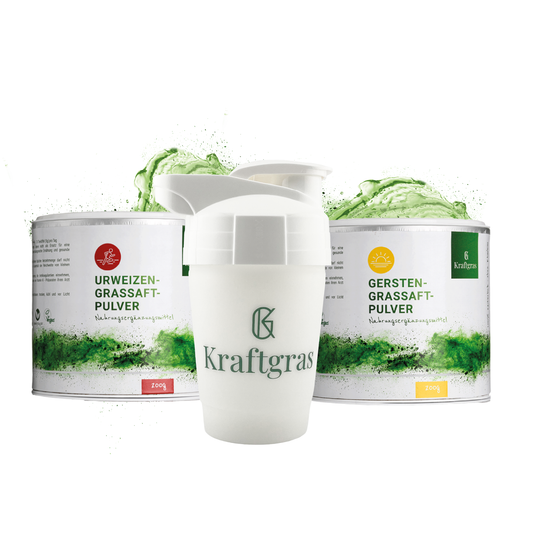
starter set with powder combo and shaker
Benefit from the effects of both wheatgrass juice and barley grass juice and also receive a shaker.
Regular price From CHF 67.00Regular price -
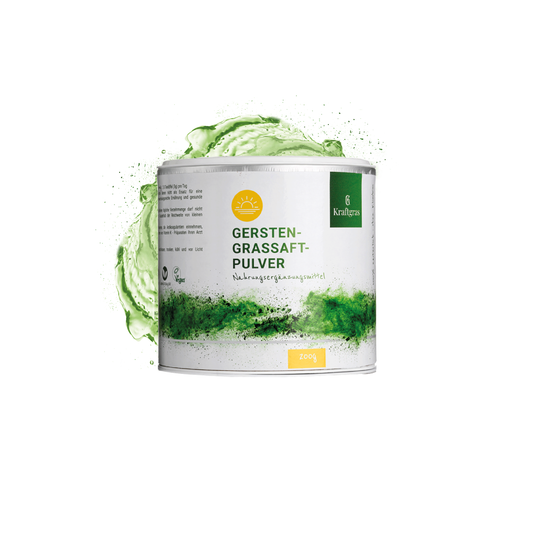
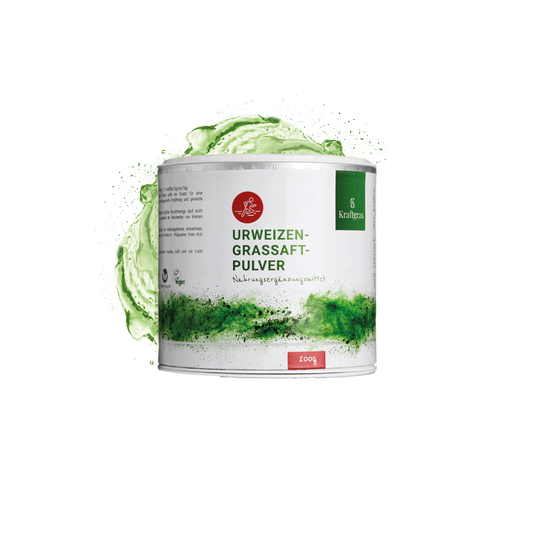
Combi organic ancient wheat and barley grass juice powder
Benefit from the effects of both wheatgrass juice and barley grass juice.
Regular price CHF 58.00Regular priceUnit price CHF 145.00/kg


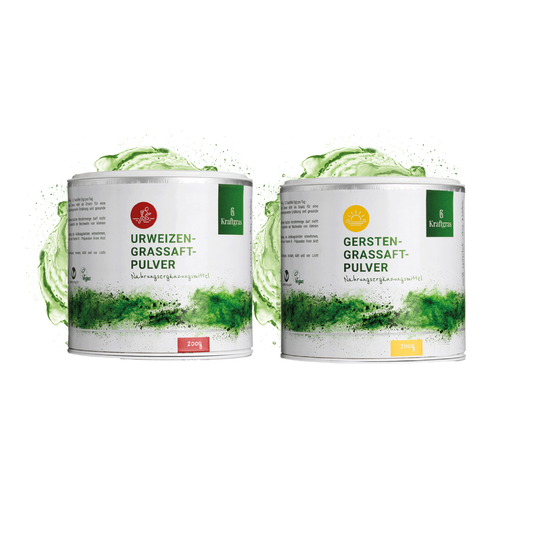
Both come from the same young leaf. For grass powder, the entire plant is dried and ground, retaining the insoluble plant fibers. For juice powder, the fresh plant is pressed and only the juice is processed further, with the fibers being separated. Juice powder is therefore more concentrated and dissolves completely in liquid.
Because it requires many times the amount of raw material. For one kilogram of juice powder, around 33 kilograms of fresh grass are pressed – for grass powder, nothing is separated, and correspondingly less grass is needed. In addition, there is the more complex process: pressing, filtering, and gentle drying within 45 minutes of harvesting. However, when calculated per serving, the difference is significantly relativized: one can lasts for about a month, which is about 65 Rappen per day. With the refill bag, the value drops to around 49 Rappen.
That depends on what you're looking for. If you specifically want to increase your fiber intake, ground grass powder is the more obvious choice for that. We're looking for a powder that dissolves completely, is easily digestible even for sensitive stomachs, and contains as much plant juice as possible in one teaspoon.
Only the young leaf is used, harvested long before the ear and thus the grain develops. Gluten is a storage protein of the grain, not the leaf. If you suffer from celiac disease, please contact us before your first purchase – we will gladly provide you with information on the analysis values of the current batch.
One to two level teaspoons daily, preferably in the morning or before training. Stir the powder into approximately 200 ml of cold water, juice, or a smoothie. A shaker or milk frother helps dissolve small lumps – these occur because we do not use anti-caking agents.
Mild-green, slightly sweet, and less earthy than powdered grass because it lacks fiber. Barley grass is considered the most accessible variety, while alfalfa is the most balanced. If you want to tone down the taste, mix the powder into apple juice or a smoothie.
The soils in Utah are rich in minerals due to marine deposits and volcanic activity, in addition to the dry climate and intense solar radiation. This combination does not exist in Switzerland. Kraftgras itself is based in St. Gallen: We select the batches, have them tested, and are responsible for the final product.
By three things: The colour is significantly more intensely green. It dissolves completely in water instead of settling as a residue. And the ingredient list explicitly states "juice powder" or "grass juice powder" – not just "barley grass powder." If the price is the same as ground grass powder, it's worth a second look.